 Rocket Ads
In Japan, points are not a perk. They are a line in the household budget.
“Japan loves points” is not something you can design a campaign against. How many people, how often, and in what form is.
Two surveys published this year answer that.
What the data says
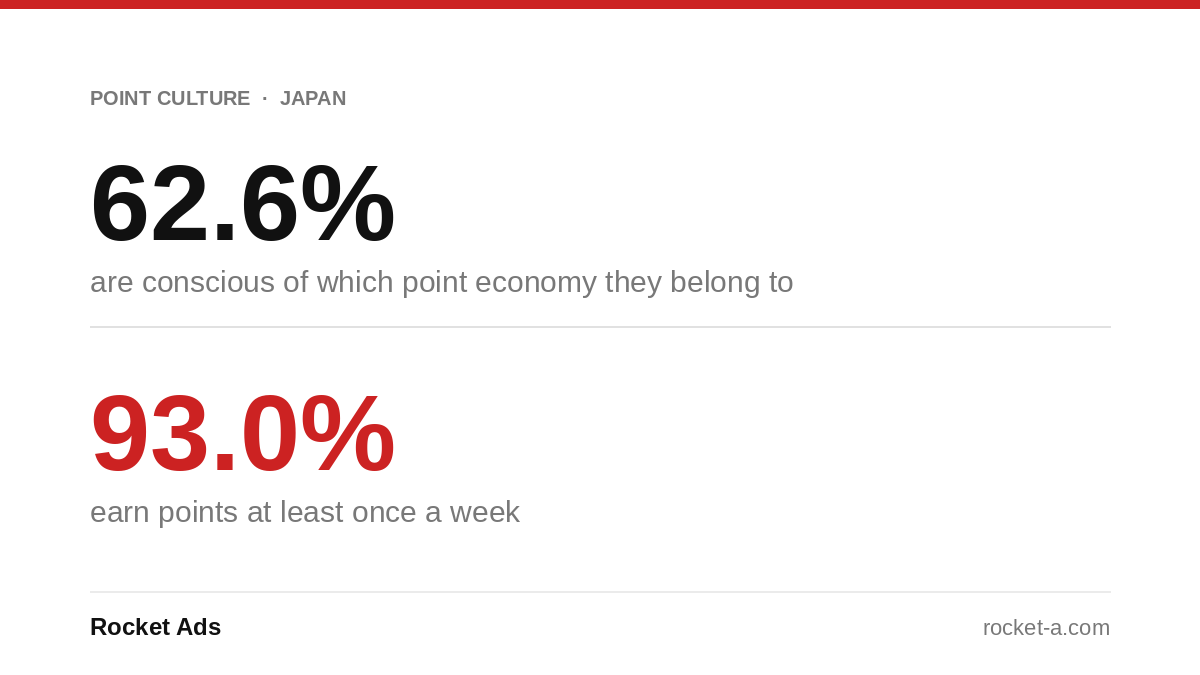
MMD Labo surveyed 25,000 people in July 2026 and found that 62.6% say they are conscious of which point economy they belong to. (Source: MMD研究所 · 2026-07 · ポイント経済圏のサービス利用に関する調査)
The word to notice there is conscious. These are not people passively collecting whatever accumulates. They are choosing a side.
The same survey asked which common points respondents currently use: Rakuten Points 58.8%, PayPay Points 41.7%, V Point 41.1%. Those add up well past 100%, because most people run several at once. But when asked to name the single one they use most, the answers split differently: Rakuten 31.8%, d Point 15.5%, PayPay Points 14.9%.
Several wallets, one center of gravity.
Frequency comes from a second source. GMO Media surveyed 23,629 people in June 2026 and found that 93.0% engage in poikatsu (point-earning activity) at least weekly, and 64.1% do it daily. (Source: GMOメディア · 2026-06 · ポイ活に関する調査)
Why a common point is not a loyalty point
In most markets, a point lives inside the brand that issued it. Coffee points buy coffee.
Japan’s common points travel. A telecom carrier, a QR payment app, and a marketplace each anchor their own economy, and inside that economy the same balance moves across convenience store purchases, phone bills, and online orders. For the user, the balance behaves less like a perk and more like a line in the household budget.
That single structural difference is what changes the math on rewarded campaigns.
What that means for an offer
A rewarded campaign gives the user points and asks for an action in return. So the value of the offer is set by what those points are worth in that user’s life, not by the number attached to them.
Where points are nice-to-have, the offer is weak, because the user has little reason to spend time on it. Where points pay part of a phone bill, the same offer carries real weight.
This is the part worth sitting with: the offer did not change. The ground underneath it did.
The assumption to re-examine
Teams outside Japan often file rewarded traffic under “cheap,” on the assumption that it attracts users who take the points and leave.
On current evidence, that assumption does not transfer cleanly to Japan. If point-earning were a fringe behaviour, “fringe user” would be a fair description. But an activity that more than nine in ten respondents do weekly is not a fringe behaviour, and the users doing it are not a separate population from the one you want.
One honest limit: both surveys above sample general consumers, not app or game users specifically. So they describe the ground, not the performance. We are not claiming here that rewarded campaigns convert better in Japan. We are saying the conditions they operate under are different, and that difference is measurable.
That generality is useful rather than limiting. Whether you publish a game, a commerce app, or a finance product, if you are asking Japanese users to try something, you are standing on the same ground.
Four things to check when you design one
- Look at where the points are spent before you look at how many. An amount that cannot be spent anywhere the user already goes does not get more persuasive by going up.
- Check which economy the media sits inside. Different media connect to different point systems. Your audience runs several but centres on one, so the match matters more than the headline reach.
- Remember the offer is never read alone. Users see your offer on a screen beside other companies’ offers and compare them. We covered that separately in Japanese Players Don’t Evaluate Your Reward Offer, They Compare It.
- Fit the completion condition into a normal day. Users who treat points seriously also calculate how many days your condition will take. A condition that falls outside their routine does not get started, let alone finished.
Closing
Rewarded campaigns work in Japan because points already sit inside daily life and users treat them seriously. The size of the reward is the smaller half of the question. The larger half is which economy the reward belongs to.
That is why we keep connecting advertisers directly to Japanese local media rather than through an intermediary layer. Sitting inside the right economy is what turns a number on a screen into something the user reads as value.
For more data and insights, explore our articles on rocket-a.com or follow our LinkedIn page.