 Rocket Ads
What is the best channel for getting an app known in Japan?
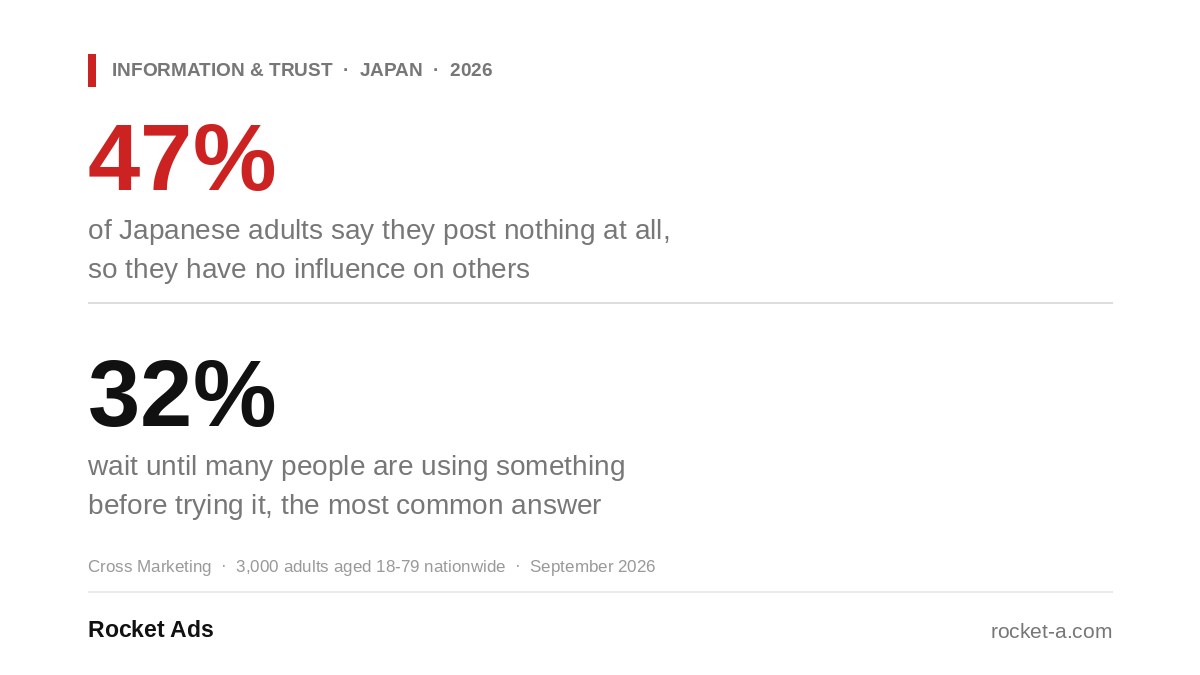
The question needs rephrasing, because in Japan the channel that reaches the most people is not the channel they trust. In a nationwide survey of 3,000 adults aged 18 to 79 conducted in September 2026, 63% said they trust word of mouth from family, while posts by ordinary individuals and by celebrities and influencers both fell below 20% (Cross Marketing, 2026). In the same survey, 47% said they send out no information at all and therefore have no influence on others. Word of mouth is the most trusted source in Japan, and it is also the one you are least able to manufacture. What you can build instead is the condition the largest group of Japanese consumers is waiting for, which is evidence that other people are already using your app.
Reach and trust do not point to the same place
Start with reach. NTT Docomo's Mobile Society Research Institute surveyed 6,748 people aged 15 to 79 across Japan in January 2026 and found usage rates of 47.1% for X, 46.3% for Instagram, 26.6% for TikTok, 25.6% for Facebook and 11.3% for Threads (Mobile Society Research Institute, 2026). Close to half the adult population is on the two largest platforms.
Now trust. In the Cross Marketing survey, the share who said they trust or somewhat trust a source was 63% for word of mouth from family, 61% for NHK television programmes, and 60% for the official websites and social accounts of public institutions. All three rose with age. For posts by ordinary individuals and by celebrities and influencers, the release states that both fall below 20% (Cross Marketing, 2026).
These are two separate surveys, with different fieldwork dates and different age ranges, so the figures cannot be subtracted from or divided into one another. The direction, though, is not ambiguous. Social platforms are where the people are. They are not where the belief is.
The number that stops a word of mouth plan
The usual response at this point is to go and create trusted word of mouth. The same survey contains the figure that gets in the way.
Asked about their own information diffusion, 47% chose "I do not send out any information at all, so I have no influence" (Cross Marketing, 2026). Close to half the sample described themselves as non-participants in the very thing the plan depends on.
That tells you two things at once. The source with the highest trust, word of mouth from family, is not a material you can commission. And the pool of people available to amplify on your behalf is thinner than a reach chart suggests. It is a large part of why campaigns built around user generated posts tend to underperform their plan in Japan.
The most common answer was to wait
So when do people in Japan start using something new?
In the same survey, the most selected answer was "I wait until many people are using it before I buy or use something new", at 32% (Cross Marketing, 2026). The other options were buying before anyone around them, and gathering information themselves and buying before the people around them start. Both of those skewed younger.
32% is the largest answer, not a majority, and that is worth stating plainly. But the single biggest block of Japanese adults describes its own behaviour as going second on purpose.
What you can build is not word of mouth
Put the three findings next to each other and the user becomes fairly legible. They are on social platforms, they do not particularly believe what they see posted there, they do not post much themselves, and they move after other people have moved.
What that person needs is not persuasion. It is precedent. And precedent is not written in ad copy. It is made of the number of people who have already started.
That also suggests reversing the usual order. The default sequence is to build awareness and wait for installs to follow. In Japan, the sequence that matches the survey is to create a visible number of early users quickly, and let that number do the work of bringing the next group.
Where rewarded campaigns fit
A reward placement runs the same offer with many users at the same time, over a short window. That structure means something specific here. The fact that this many people started this game this week is produced by the campaign itself, rather than bought from somewhere else. The condition the 32% are waiting for becomes an output of the media rather than an input you have to source.
One limit should be stated clearly. This is a survey about how people gather information, not a survey about apps. Respondents were not asked about installs or about advertising response, so these figures cannot be converted into install rates or completion rates. What transfers is the order in which people adopt something new. Assumptions about campaign performance still have to come from your own data.
Before you launch in Japan
First, is there anything in your plan that assumes word of mouth will circulate on its own? Read it again alongside the 47% who say they send out nothing.
Second, if user generated posts are a completion condition or a KPI, how much of the plan is resting on them?
Third, can you say how many people started in the first month? For the group that waits, that number arrives before any ad copy does.
Fourth, is that number somewhere a user can actually see it? Built and not shown is the same as not built.
Fifth, is there a proper Japanese explanation on the sources that do carry trust? One of the top three was the official websites and social accounts of public institutions, which says that trust in what is written officially is intact.
The first job is precedent, not reach
If you ask which channel gets an app known in Japan, the answer is not the name of a channel. The place with the most people and the place with the most trust have come apart, close to half the population reports sending out nothing at all, and the largest single group waits for others to go first. So the first job is not to spread a message. It is to build the precedent that the people who wait are waiting for.
This is why Rocket Ads connects advertisers directly to Japanese local reward media rather than through an intermediary layer. Knowing where you can build a visible number of early users in a short window is something you have to know the market to choose.
For more data and insights, explore our articles on rocket-a.com or follow our LinkedIn page.
If you're planning UA in Japan or want to consult on your current campaign strategy, reach out anytime.