 Rocket Ads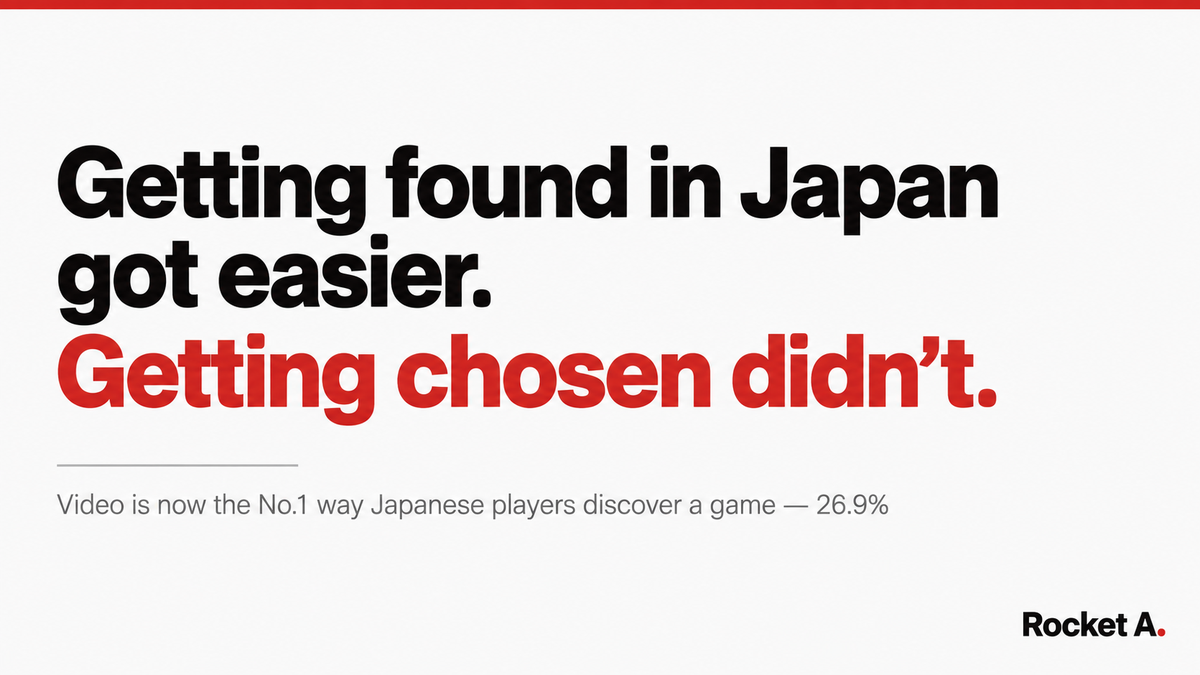
Most teams preparing a first Japan launch carry the same belief: that Japan is a market you have to be introduced into, where players find games through friends and communities and a foreign advertiser has no real way in.
That was true for a long time. Japan’s own industry data says it stopped being true around 2024.
Word of Mouth No Longer Leads
In the 2025 survey behind the Famitsu Mobile Game White Paper, the two most common ways Japanese players said they found a new game were both screens. Word of mouth from family and friends — first place through 2023 — is no longer first, and television has receded as well (Source: Famitsu Mobile Game White Paper · 2026-03 · How Players Find Games).
| How Japanese players found a new game | Share |
|---|---|
| Video services and apps | 26.9% |
| Information and advertising on the internet | 25.7% |
| Word of mouth from family and friends | No longer first (led through 2023) |
| Television | Declining influence |
The white paper publishes the top two figures and not the rest, so how far word of mouth fell isn’t public. What is public is that it no longer leads.
The Money Moved the Same Way
Japanese ad spending followed. Internet advertising passed half of all Japanese ad spend in 2025, the first time since records began in 1996 (Source: Dentsu · 2026-03 · Japan Ad Expenditures), and video is the fastest-moving part of it (Source: CyberAgent · 2026-03 · Japan Video Ad Market).
| Japan ad spend, 2025 | Figure | YoY |
|---|---|---|
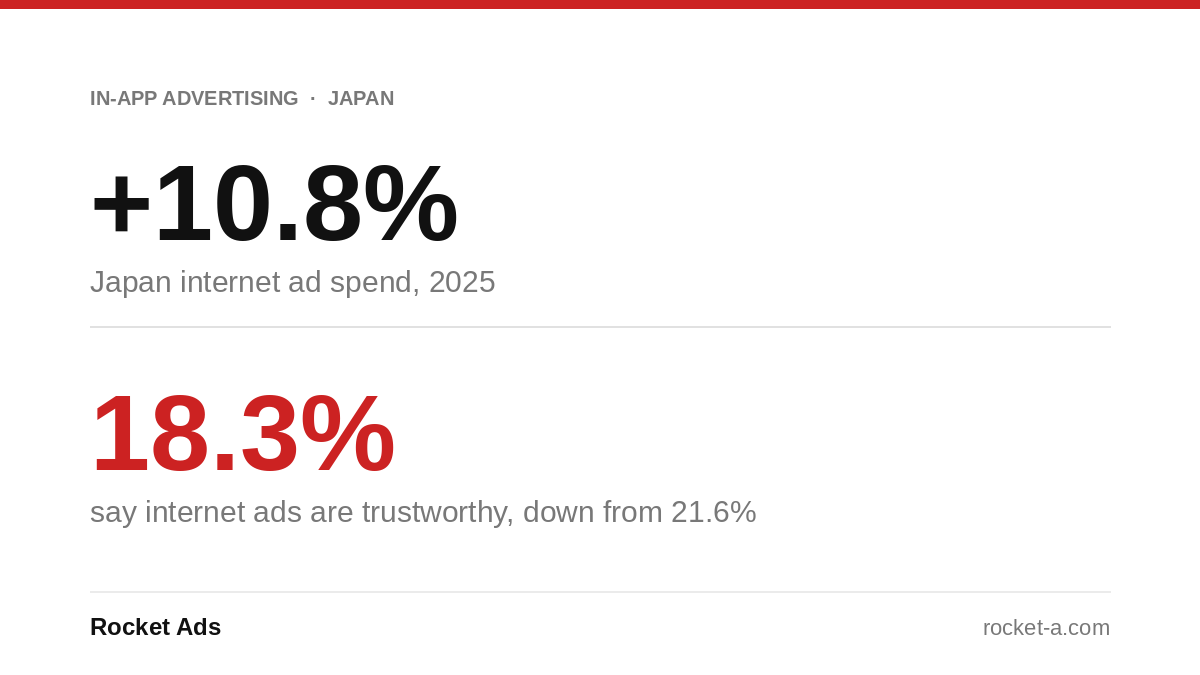
| Internet advertising | ¥4.05tn — 50.2% of all ad spend | +10.8% |
| Video advertising | ¥885.5bn | +22.2% |
| Vertical video | ¥204.9bn — 29.1% of smartphone video | +55.9% |
For a foreign marketer that is the good news. The discovery layer in Japan is now a layer you can buy into.
More Reach Did Not Become More Installs
The installs did not follow. Over the most recent twelve months, Japanese mobile game downloads fell 5.4% to 585 million and in-app purchase revenue fell 5.1% to $10 billion (Source: Sensor Tower · 2026-09 · Japan Game Market Insights).
The two sets of numbers sit in slightly different windows — discovery and ad spend describe calendar 2025, downloads a rolling twelve months — but the direction isn’t ambiguous. Reach got easier to buy. Fewer people started something new.
Whatever is limiting a Japan launch right now, it is not the ability to be seen.
The Players Went Deeper, Not Away
The obvious reading is that the audience shrank. The data says the opposite.
| Per Japanese player | 2024 | 2025 |
|---|---|---|
| Play days per month | 16.02 | 16.44 |
| Weekday play time | 1.15 h | 1.28 h |
| Weekend play time | 1.50 h | 1.69 h |
Total time spent in Japanese mobile games held at 16.7 billion hours while downloads fell, and the share of players who agree that paying lets them enjoy a game more deeply grew (Source: Famitsu Mobile Game White Paper · 2026-03 · Play Behaviour). The same people are playing more, paying more willingly, and starting fewer new games.
What Is Actually Scarce
Three things are true at once. Reach is abundant and easier to buy than it has ever been. New installs are getting harder. And the players already there are more engaged than a year ago.
That changes what a budget competes for. Impressions are not the scarce input, and neither is awareness. What is scarce is the moment a player who has already seen you decides to start, and then goes far enough in to be worth what you paid.
Japan’s UA playbook was built for the opposite problem — buy exposure, widen awareness, expect installs to follow. In a market where being found was hard, that was the right shape. It is no longer the shape of the problem.
Buying a Reason, Not an Impression
If what is scarce is the decision, that is where the budget should point.
That is what motivation-based acquisition does. It gives a player a concrete reason to start now, and the cost lands when that player has completed a step inside the game rather than when an ad was served. In a market with surplus exposure and scarce commitment, it puts spend on the side that is short.
It also explains why the media layer matters more than it used to. The channels sitting at that decision point in Japan — reward and point-based media, where a player trades a defined action for something concrete — are overwhelmingly domestic. They aren’t reachable through the platforms a foreign team already has open, and they aren’t bought the same way.
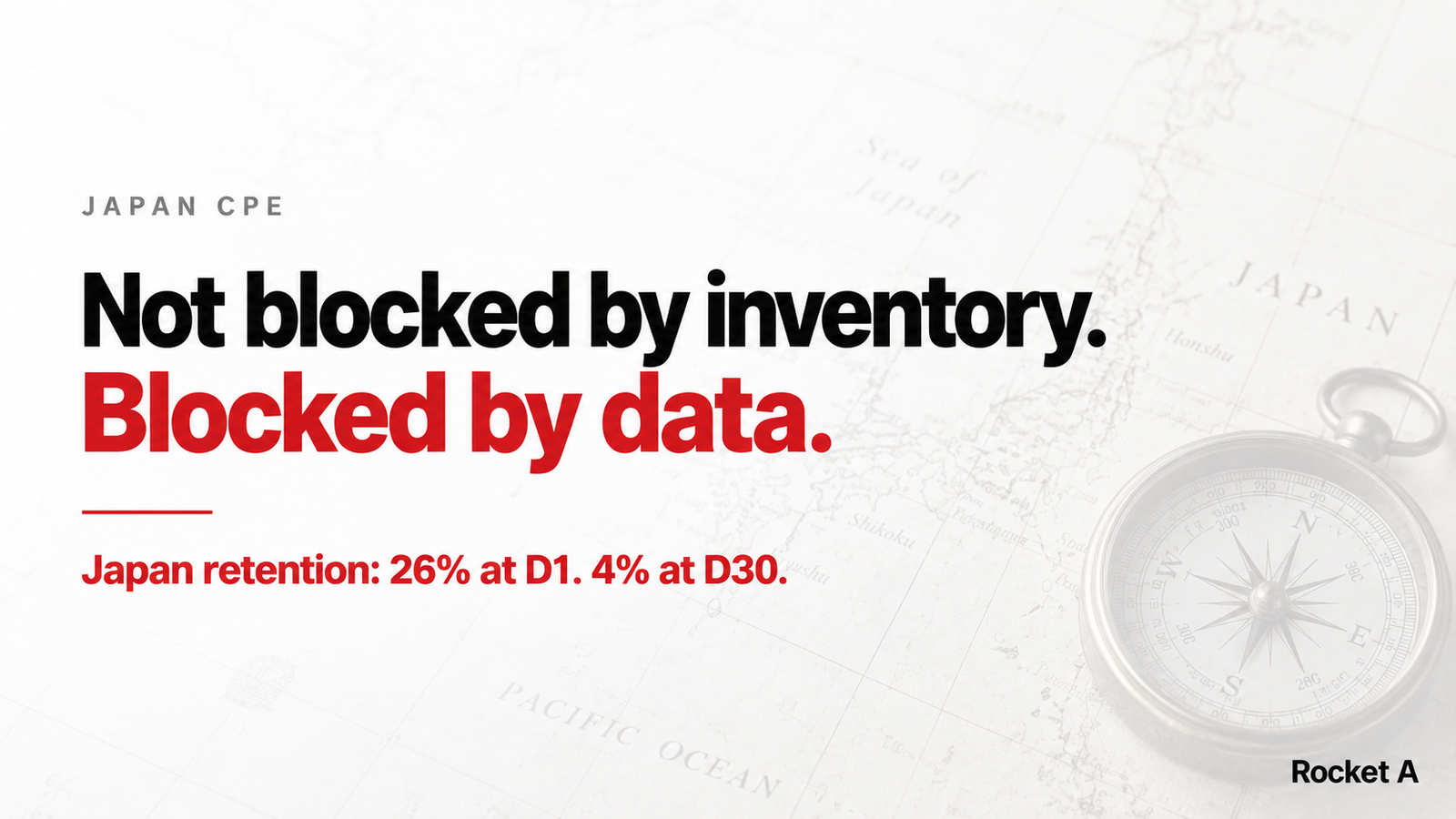
When Indovia built its Japan mix, 95% of it ran on CPE for this reason.
Japan is no longer a market you have to be introduced into. Being seen is the easy half now. The other half is giving someone a reason.
For more data and insights, explore our articles on rocket-a.com or follow our LinkedIn page.
If you’re interested in running campaigns across Japan’s local media, you’ll find introductory materials, campaign references, and estimated simulation data tailored to your app right here on the site.