 Rocket Ads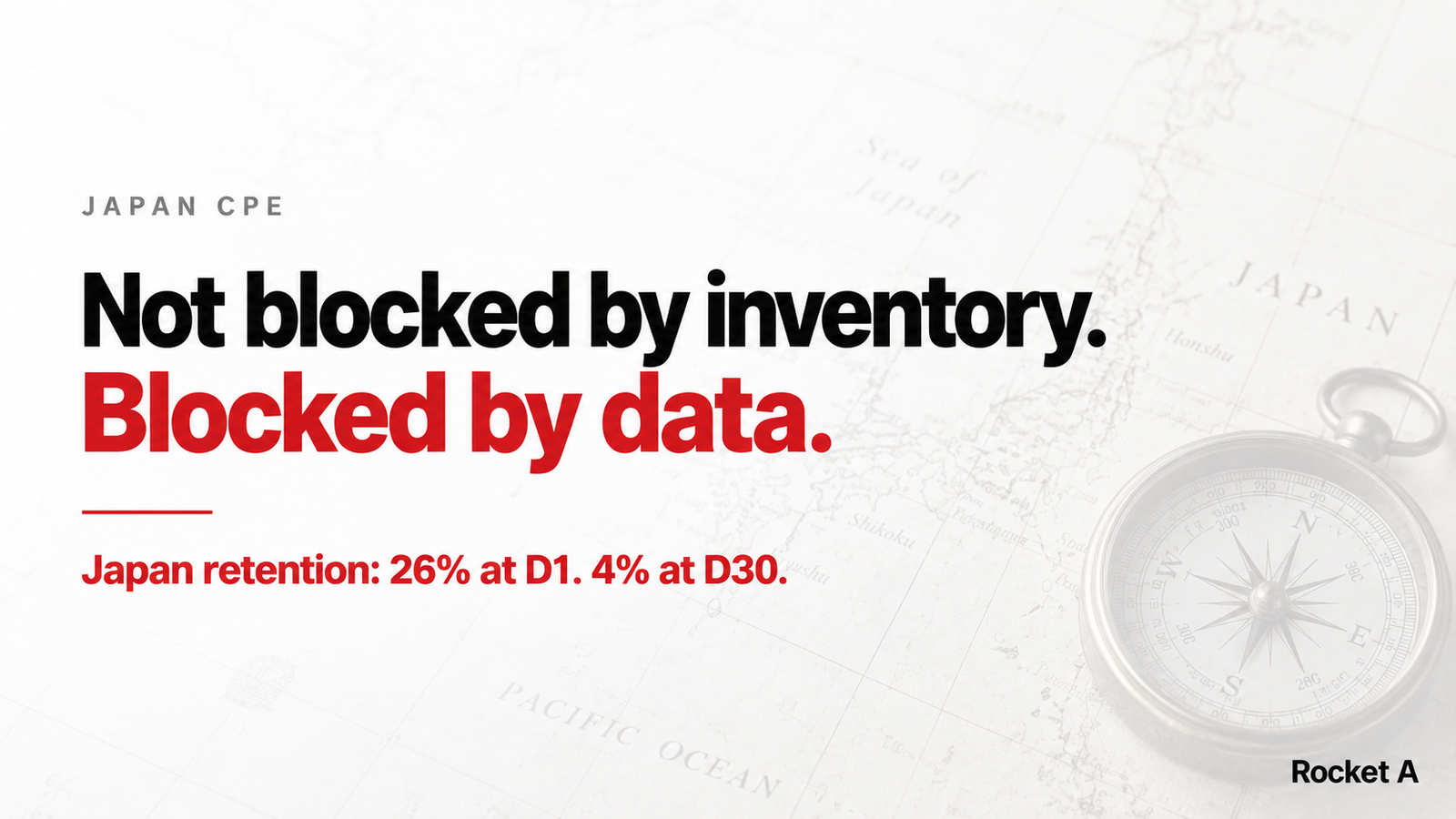
What explorers heading for a new continent feared most was never the obvious thing. Not running out of food. Not disease. Not storms.
It was not knowing when they would arrive — and not knowing whether this was the right route at all.
Teams preparing a first CPE campaign in Japan meet the same two fears. What stops them usually isn’t securing inventory. It’s three numbers that aren’t in their hands yet.
When Indovia ran its first CPE campaigns in Japan, the problem that surfaced wasn’t distribution — it was data. Modeling a CPE campaign properly requires a confirmed D30 ARPU, revenue broken out by level depth, and a clear read on each channel’s payout structure. On a first Japan launch, none of the three is usually sitting there waiting for you.
Here’s why each one is missing, and what to do about it.
The First Number: A Confirmed D30 ARPU
You can’t size a reward event ladder without knowing what a user is worth at D30. On a new title that number doesn’t exist yet — and in Japan it takes longer to exist than most plans assume.
Japanese retention runs 26% at D1, 11% at D7, and 4% at D30 (Source: Adjust × Sensor Tower_2026_Japan’s Mobile Market). By the time a D30 cohort has formed, it’s thin. That has two consequences worth separating. The number arrives late, and anything you read before it arrives sits on a small base — which means an early read isn’t just incomplete, it’s unstable.
The practical answer isn’t to wait passively. It’s to treat the opening phase as a separate budget line with a different job. Indovia runs the first stretch of a Japan launch as a deliberate data-collection exercise and re-forecasts once the deep funnel produces real numbers, rather than committing to a full ladder against assumptions borrowed from Western pacing.
The Second Number: Revenue by Level Depth
Most teams already hold this data. Very few have it split the way a CPE ladder needs.
A blended ARPU tells you what an average user is worth. It doesn’t tell you where value accumulates across progression, and in Japan that distinction decides the campaign. Japanese players tend to go deep, so a disproportionate share of revenue sits in the mid- and late-funnel rather than in the first few sessions. Anchor reward events against a blended average and you’ll place them where the arithmetic looks reasonable and the revenue isn’t.
No media partner can produce this number for you. It comes out of your own analytics, and it has to be pulled before the ladder is designed rather than reverse-engineered after the first cohort disappoints.
The Third Number: Each Channel’s Payout Structure
The same completion condition does not produce the same completion rate everywhere.
What a user actually receives — the form of the reward, its size relative to the effort asked, how it sits inside that channel’s own coin economy — differs by media partner, and it moves behavior directly. Two channels running an identical event on the same day will return different drop-off curves.
This is the one number you cannot derive from your own data. It isn’t published, and it rarely appears in a media kit. It comes from whoever is connected to that channel directly, which is why the choice of partner in Japan is a data question before it is a pricing question.
| The number | Why it's missing at launch | How to get it |
|---|---|---|
| Confirmed D30 ARPU | A new title has no D30 cohort yet, and Japan's D30 retention sits at 4% | Run the opening phase as a data-collection budget, then re-forecast |
| Revenue by level depth | Usually held as a blended ARPU, not split across progression | Pull it from your own analytics before the ladder is designed |
| Channel payout structure | Not published, and rarely in a media kit | Comes from a partner connected to the channel directly |
Instruments, Not Effort
Explorers didn’t solve their problem by sailing harder. They solved it by carrying better instruments.
These three numbers are the instruments. D30 ARPU tells you when you arrive. Revenue by depth tells you whether the route is right. The payout structure tells you what conditions look like along the way.
Until you have them, you aren’t running a campaign yet — you’re collecting what lets you run one. The teams that do well in Japan are the ones who budget for that stretch on purpose, instead of discovering it somewhere in the middle of the voyage.
For more data and insights, explore our articles on rocket-a.com or follow our LinkedIn page.
If you’re interested in running campaigns across Japan’s local media, you’ll find introductory materials, campaign references, and estimated simulation data tailored to your app right here on the site.